
AI in Healthcare: What’s Actually Working?
A field review for healthcare leaders evaluating whether an AI investment is worth making and what it takes to make one work.
Conversations about AI and ROI in healthcare are built on a mix of peer-reviewed research, health-system self-reports, and vendor marketing. A randomized trial and a customer-success story can both be true and still deserve very different weight in making a business case.
The five cases described here are organized by evidence tier, and each carries its own sources. Three are medical, two are dental — chosen because each has a specific, verifiable outcome, not a projection.
1. The Permanente Medical Group — Ambient AI Documentation
2. Johns Hopkins — TREWS Sepsis Early-Warning System
3. MASAI Trial — AI-Supported Mammography Screening (Sweden)
4. Costa Verde Dental (Signature Dental Partners) — AI-Assisted Radiograph Review
5. Pearl AI — Practice Intelligence & Second Opinion (Multi-Office DSO Studies)
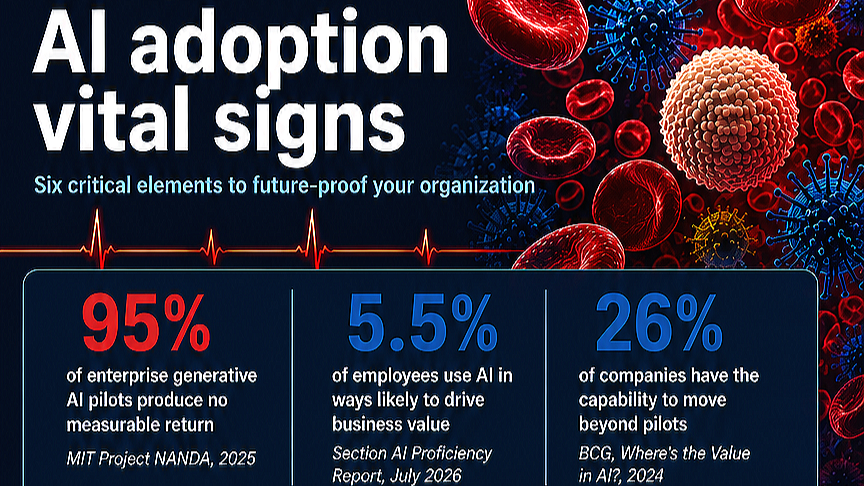
AI Adoption Vital Signs
You were told AI would change everything. You bought the licenses. You ran the pilot. Somewhere between the demo and the quarterly review, the promise thinned out.
If that is your experience, you are not behind. You are in the majority, and the reason is now well documented.
This guide will not tell you which tool to buy. It will show you the six conditions that determine whether any tool creates value, why organizations skip them, and what it costs when they do. Read it and you should be able to say, with justified confidence, where your own gap is and what the responsible next step looks like.

Why Your AI Investment Failed (And What You're Missing)
The AI Adoption Crisis Is a People Crisis. There are three human reasons AI initiatives derail.

Why 90% of AI Initiatives Fail: The Change Management Crisis Nobody's Talking About
If you treat an AI implementation as a pure technology project, you're ignoring the psychological and emotional dimensions that actually determine whether people adopt or resist.