
AI in Healthcare: What’s Actually Working?
INSIGHTS · EVIDENCE REVIEW
Five Verified Cases:
What AI Is Actually Delivering in Medicine and Dentistry
A field review for healthcare leaders evaluating whether an AI investment is worth making — and what it takes to make one work.
Most conversations about AI and ROI in healthcare are built on a mix of peer-reviewed research, health-system self-reports, and vendor marketing — often without saying which is which. That distinction matters. A randomized trial and a customer-success story can both be true and still deserve very different weight in making a business case.
The five cases below are organized by evidence tier, not by how impressive the number sounds, and each carries its own sources. Three are medical, two are dental — chosen because each has a specific, verifiable outcome, not a projection.
1. The Permanente Medical Group — Ambient AI Documentation
EVIDENCE TIER: INTERNAL HEALTH-SYSTEM DATA, PUBLICLY REPORTED
The Permanente Medical Group, part of Kaiser Permanente, rolled out an ambient AI documentation tool (Abridge) to its physicians between October 2023 and December 2024. By year-end, 7,260 physicians had used it across more than 2.5 million patient encounters, with over 3,400 physicians using it in at least 100 visits.
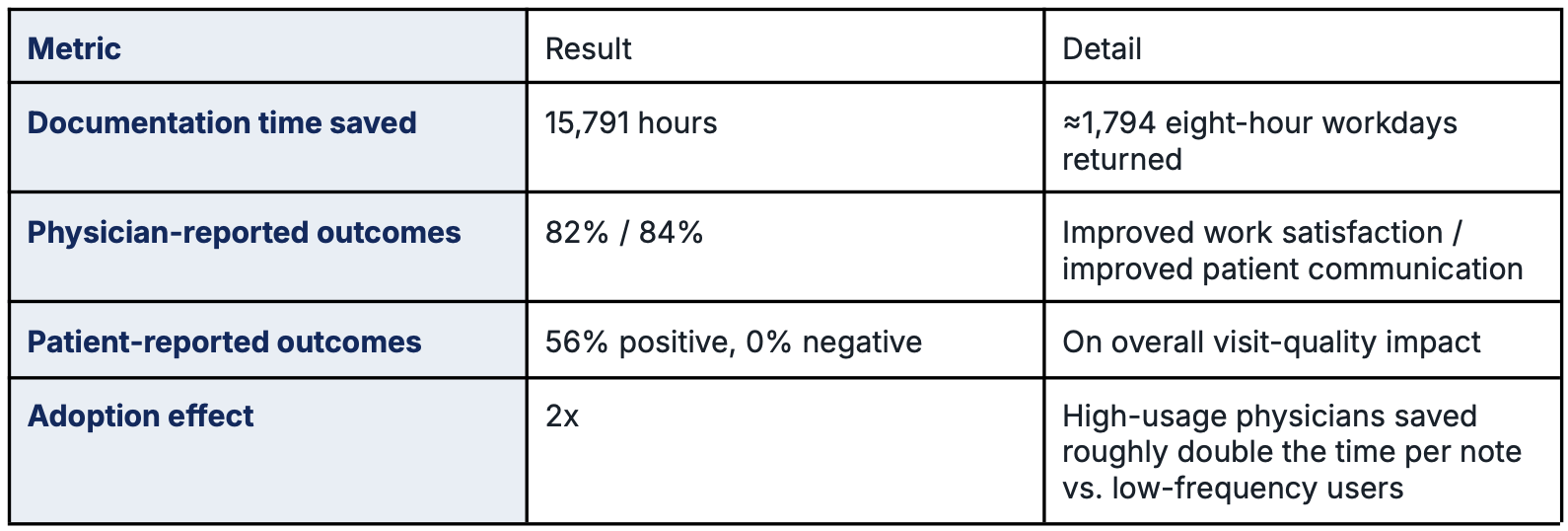
Finding: The time savings were real, but they scaled with how much a physician actually used the tool — the technology did not create value on its own; adoption intensity did.
Sources
— AMA — AI scribes save 15,000 hours and restore the human side of medicine
— Permanente Medicine — Lessons learned from the Kaiser Permanente rollout of ambient AI scribes
2. Johns Hopkins — TREWS Sepsis Early-Warning System
EVIDENCE TIER: PEER-REVIEWED CLINICAL STUDY (NATURE MEDICINE)
Johns Hopkins deployed a machine-learning early-warning system (TREWS) for sepsis across five hospitals, monitoring 590,736 patients; 6,877 sepsis cases were analyzed for the primary outcome. This is the one case on this list with a genuine control comparison and a peer-reviewed publication behind it.
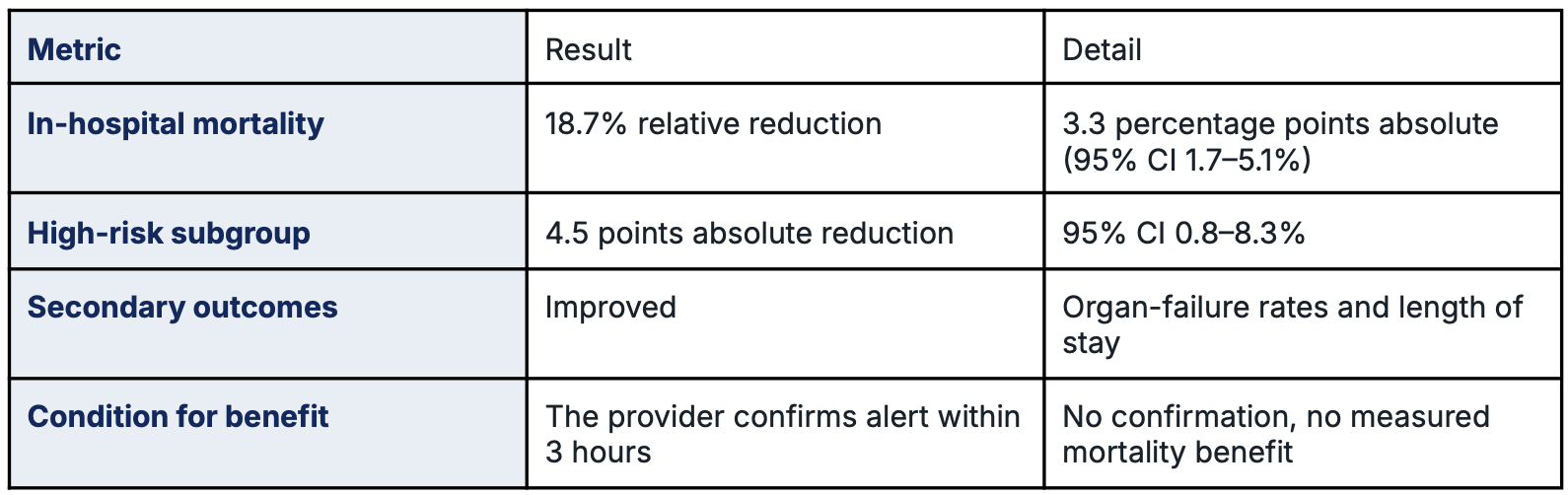
Finding: The algorithm's accuracy wasn't what saved lives — the mortality benefit only appeared when a clinician acted on the alert within three hours. This is the cleanest published proof that AI value is gated by workflow and trust, not model performance alone.
Sources
— Nature Medicine — Prospective, multi-site study of patient outcomes after implementation of TREWS
— Johns Hopkins Medicine — Study shows Johns Hopkins AI system catches sepsis sooner
3. MASAI Trial — AI-Supported Mammography Screening (Sweden)
EVIDENCE TIER: PEER-REVIEWED RANDOMIZED CONTROLLED TRIAL (THE LANCET)
MASAI is the first randomized controlled trial of AI-supported mammography screening, run across four Swedish screening sites from April 2021 to December 2022 with over 100,000 women, with full results published in The Lancet in January 2026 after earlier interim results in The Lancet Oncology.
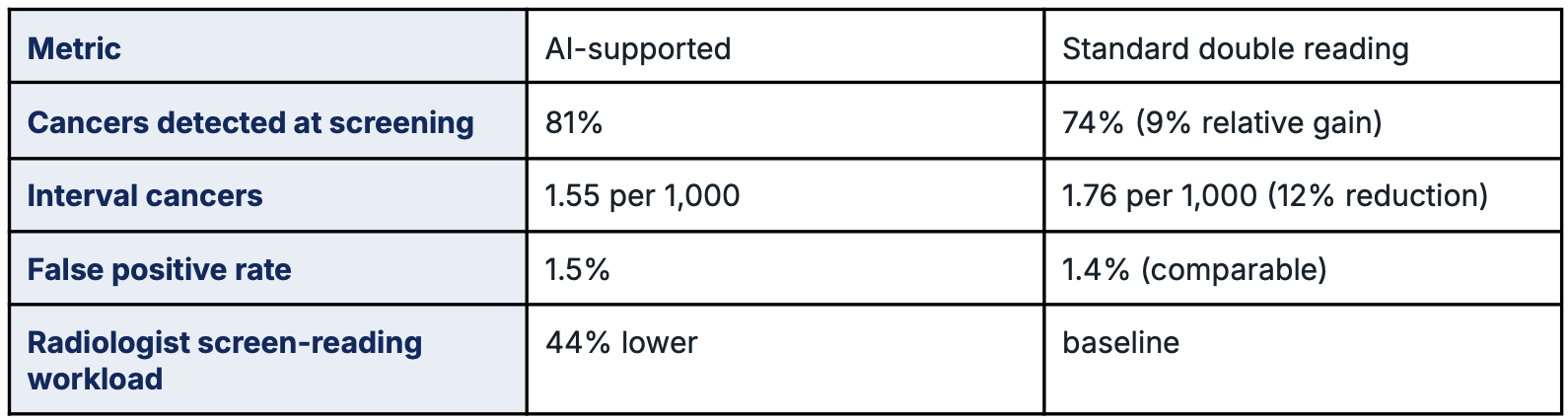
Finding: AI-supported reading caught more cancer, including more aggressive and advanced disease, while nearly halving radiologist reading workload — a rare case where quality and capacity improved together rather than trading off.
Sources
— EurekAlert / The Lancet — Full results from the first randomized controlled trial in breast AI
— The Lancet Digital Health — Screening performance and characteristics of breast cancer detected in MASAI
4. Costa Verde Dental (Signature Dental Partners) — AI-Assisted Radiograph Review
EVIDENCE TIER: VENDOR-PUBLISHED CASE STUDY — VERIFY INDEPENDENTLY BEFORE USE IN A BUSINESS CASE
Signature Dental Partners, a DSO of 100+ offices and 150+ dentists, piloted Overjet's AI radiograph-analysis platform at its Costa Verde Dental location under Dr. A. Agustin Vega. The figures below come from Overjet's own case study, attributed to a regional manager's account rather than an audited financial statement—treat the multiple as directional, not a guaranteed outcome.
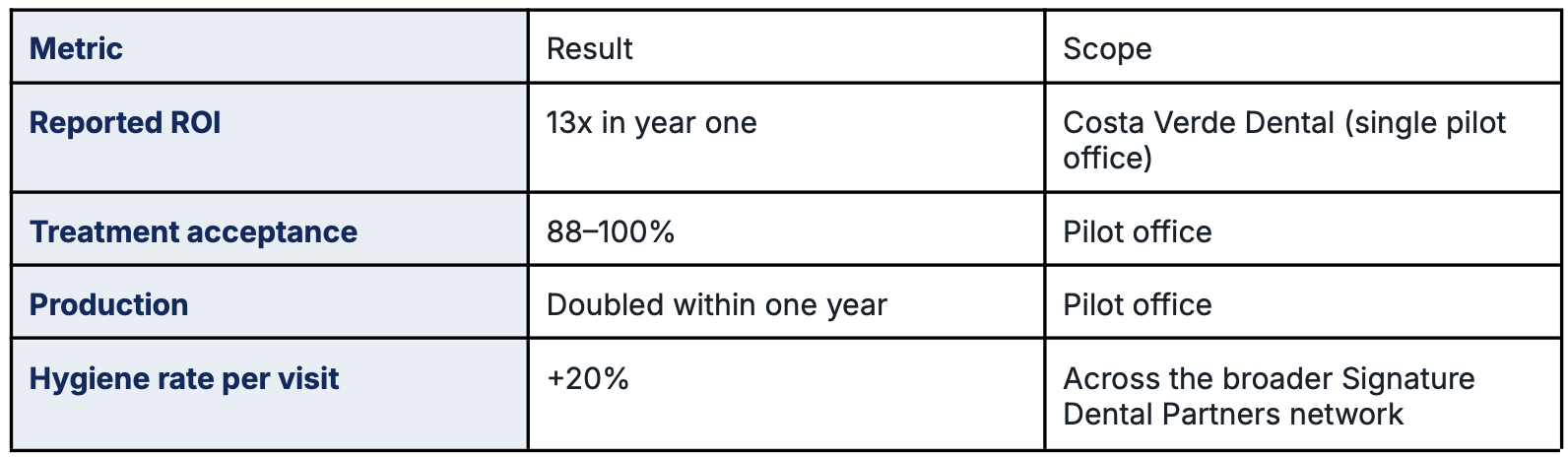
Finding: The mechanism is credible and consistent with other dental-AI evidence — color-annotated radiographs improving patient understanding and case acceptance in the chair. The specific 13x figure is a single-site, vendor-reported number and should be re-derived from your own case-acceptance and production data before it goes in a pro forma.
Source
— Overjet — How Signature Dental Partners achieved 13x ROI with Overjet AI at Costa Verde Dental
5. Pearl AI — Practice Intelligence & Second Opinion (Multi-Office DSO Studies)
EVIDENCE TIER: VENDOR-COMMISSIONED STUDY — CONTROLLED DESIGN, BUT FUNDED AND PUBLISHED BY THE VENDOR
Pearl ran two studies of its Second Opinion (real-time pathology detection) and Practice Intelligence (performance analytics) products: a longitudinal comparison across 31 pilot offices over 8+ weeks and a controlled parallel-group study of 12 Pearl offices against 5 non-Pearl control offices over 11 weeks — a more rigorous design than a single testimonial, though still self-published.
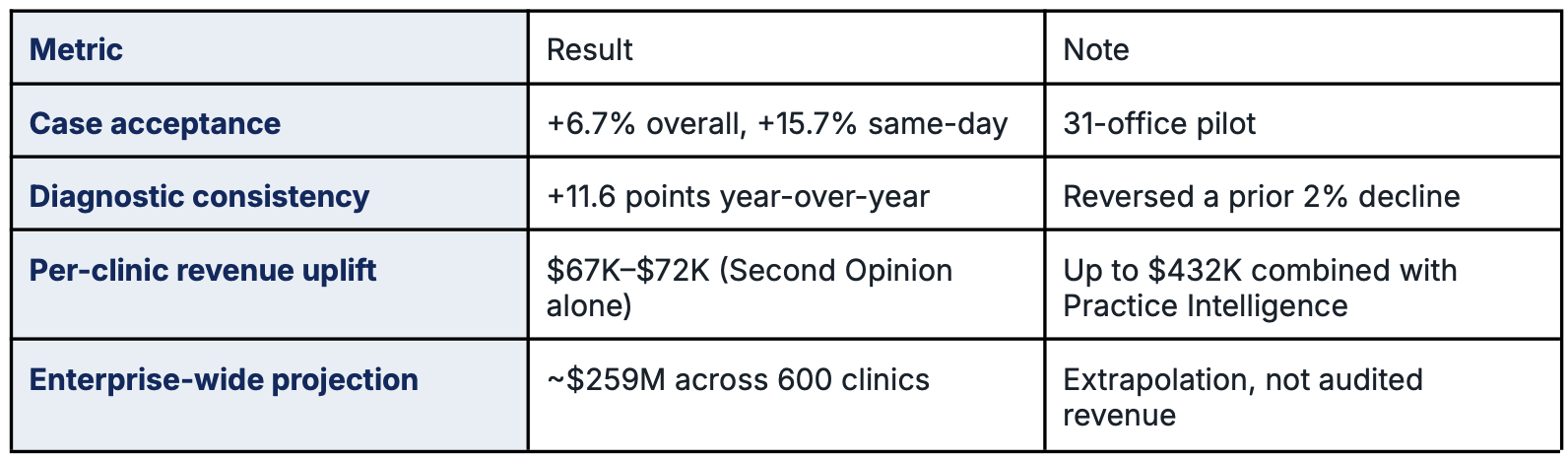
Finding: The office-level, controlled results (case acceptance, diagnostic consistency) are the credible part of this study. The enterprise-wide dollar figures are projections built on that per-clinic data, not a reported financial result — worth citing the mechanism, not the headline number.
Source
— Pearl — Case study: How DSOs scale clearer presentations into new revenue
What the Pattern Shows
Across all five cases, the technology never created value by itself. Kaiser's time savings scaled with adoption intensity, not tool access. Johns Hopkins' mortality reduction depended on a clinician trusting and acting on an alert within three hours — the same algorithm produced no measured benefit when that workflow step didn't happen. MASAI's workload reduction only holds if radiologists actually change how they triage cases around the AI's first read. And the dental cases, however you weight the vendor framing, describe the same mechanism: AI changes a conversation in the chair, but a team still has to have that conversation differently for the number to move.
The evidence above says AI capability to improve healthcare outcomes is real and, in several cases, rigorously proven. Whether it produces your organization's version of these numbers depends on leadership clarity, workflow design, governance, the change management plan, and whether your teams trust the tool enough to change what they do with it — not on the technology alone. Healthcare organizations can benefit significantly from bridging the gap between AI capability and human readiness.
